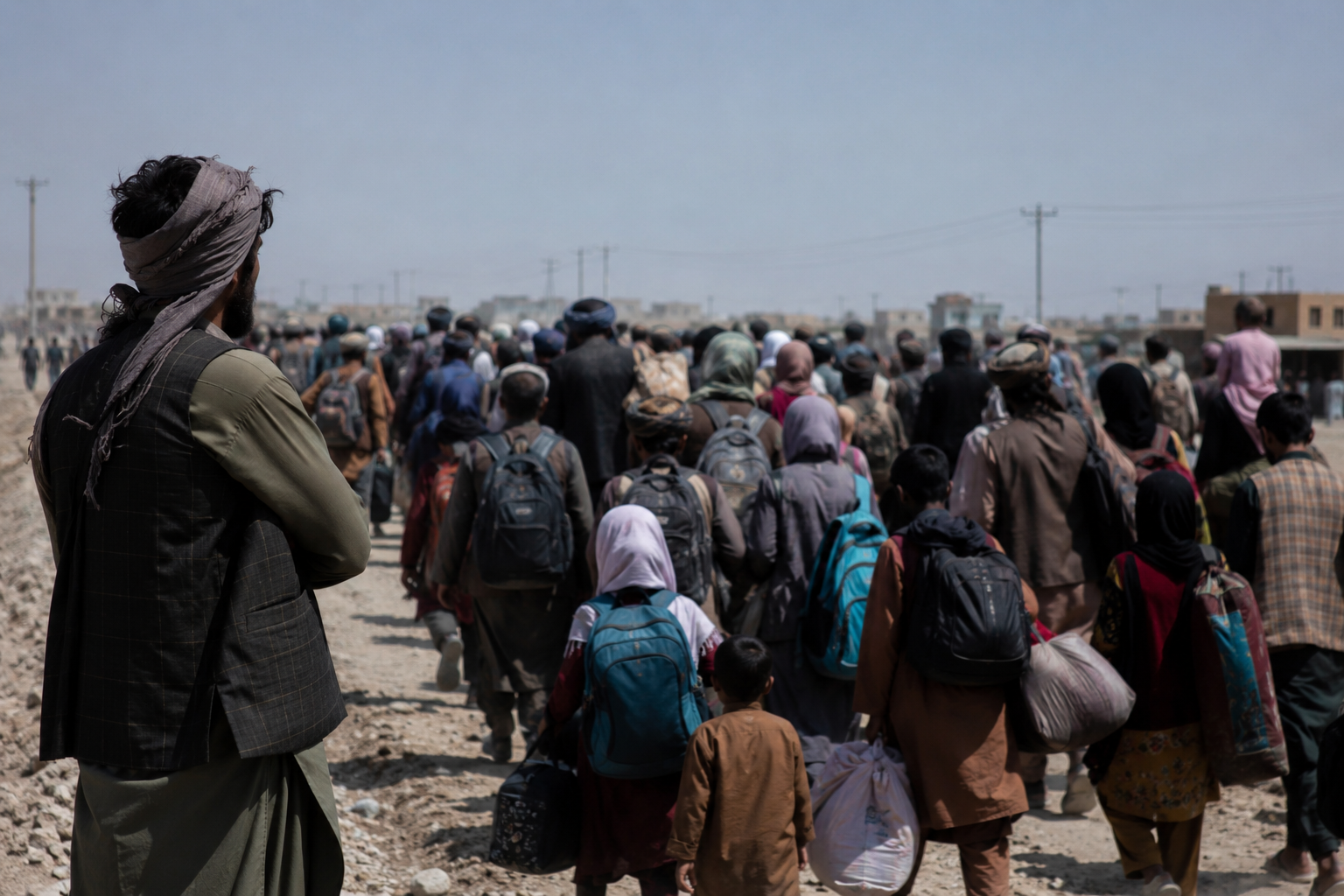
Since late 2023, millions of Afghans have been deported from Iran and Pakistan despite holding documents that had long permitted them to live and work, yet both governments describe the removals as nothing more than routine immigration enforcement. The mass displacement of Afghans has created not just a humanitarian crisis but a fertile recruiting ground for the Islamic State of Khorasan Province (ISKP).
ISKP is an active regional branch of Islamic State which was formed in 2015 by fighters dissatisfied with Tehrik-i-Taliban Pakistan (TTP) or the Afghan Taliban because they felt that their original leaders were too moderate, too corrupt or overtly focused on local politics rather than focusing on establishing a global caliphate. In addition to emerging as a principal internal security threat after Taliban’s return to power in Kabul, ISKP has also become a regional threat due to its reported targeting of civilians returning from Iran whose treatment as a religious minority in the Islamic Republic has produced resentment that the militant group can leverage.
According to a World Development Report (2011), displaced people are often seen as a recruitment pool by armed movements especially if concentrated near a contested border, with social and ethnic ties to active rebels on the other side. Interestingly, the report also reveals that only two countries in the historical record, Pakistan and Chad, have seen refugees become combatants in the host state’s own internal war, and across all refugee hosting states the rate of any political violence by refugees sits at 15 percent. The pattern suggests that most refugee crises do not turn into security crises for their hosts. The cases that do tip into militarisation are best explained by the political context of reception: whether the host state acts to prevent military activity, or leaves the ground fertile enough for recruitment to take root. For example, in the 1980s the millions of Afghans hosted in Iran did not militarise, while across the same decade the mujahideen who fought over the border were recruited from the refugee camps strung along Pakistan’s frontier, where the camps sat beyond effective state control and outside powers. The case also makes the present moment legible rather than surprising, since the same borders, and the same destitution are once again producing the same opportunity for armed groups.
ISKP’s Recruitment Pool
Since October 2023, more than 5.4 million Afghans have returned from Iran and Pakistan, with 2.9 million of them returning in 2025 alone, and the early weeks of 2026 added another 232,500 . Iran had been hosting Afghan workers for decades on a document called the headcount slip, which gave at least 2.6 million people access to work, schooling and healthcare without ever amounting to a legal status. In March 2025, the government abruptly cancelled the slips.
Soon after when its war with the United States began, state media started describing Afghans as potential Israeli spies, which eventually resulted in the expulsion of more than 900,000 people in just four months. Pakistan has been on a similar course since 2023, when it launched its Illegal Foreigners Repatriation Plan. More than a million Afghans were removed in 2025. When fighting with the Taliban closed the Torkham crossing this spring, deportations slowed for as long as the crossing stayed shut. They restarted the day it reopened on 31 March, and more than 146,000 people have been pushed across the border so far this year. Human Rights Watch found raids, arbitrary detentions and forced returns surging in the weeks after the February clashes.
Researchers at the Soufan Center and others have noted that forced returnees, facing poverty, scarce work and the resentment of expulsion, are highly susceptible to the ISKP’s recruitment, and that deportation expands the reservoir of disillusioned Afghans open to radicalisation. For those returned from Iran specifically, The Islamic State of Khorasan Province (ISKP) has been using an anti-Shia framing to draw in refugees whose treatment as a religious minority in the Islamic Republic has produced the resentment the group can work with..Some analysts like Retired Major General Raza Muhammad and former CIA officer J.D. Maddox argues that only a fraction of returnees would be open to ideological recruitment, with those already inclined likely already involved. However, it is no doubt that even a small fraction of recruitment across millions of returnees produces operationally meaningful numbers, and the conditions of return are the conditions extremist groups have historically exploited. Overall, this is an opportunity for the ISKP to rebuild their operational capacity and expand recruitment while both states are distracted fighting each other.
Prospects of Containment by Taliban
Taliban has a sharp interest in containing ISKP, which is the only force currently challenging their consolidation of rule. The organisation has also reportedly assassinated a senior Taliban official, the Minister of Refugee Khalil-ur-Rehman Haqqani in December 2024. Although regional security cooperation and Taliban military actions has resulted in fewer ISKP attacks, the group has retained “significant operational and combat capability and the ability to rapidly replace fighters, including through online recruitment”. Yet, the problem does not motivate the Taliban government to protect returnees from recruitment, for two reasons.
The first is capacity. Taliban has very limited fiscal and administrative capacity to absorb millions of people into anything resembling productive life, especially under international sanctions and with frozen central bank reserves. About $7 billion of Afghan Central Bank assets were held at the US Federal Reserve in August 2021 of which half of the amount was moved into a Swiss based Afghan fund in 2022 for eventual humanitarian disbursement, though no disbursements have been made. The other half remains subject to ongoing litigation from the victims of the 9/11 attack.
As a result, Afghanistan is experiencing a severe liquidity crisis as a cash dependent country. The scale of return has further exacerbated the situation by outpacing the country’s economic expansion, producing a 5.6 percent decline in GDP per capita in 2025 compounding poverty and food insecurity. Overall, Afghanistan has the macroeconomic profile of a state in slow recovery and the practical capacity of a state that cannot absorb a population shock of this scale. The second is political. Many of the returnees are the people the Taliban government itself had displaced in the first place, including Ghani-era government and security personnel, ethnic Hazaras, women who fled rather than live under the new rule, and educated professionals associated with the previous order.
The recruitment risk therefore exists in a gap. The Taliban government wants ISKP gone as an organisation but has neither the capacity nor the will to protect the population ISKP is most likely to draw on. Besides, removing ISKP fighters through military operations does nothing to address the poverty, statelessness and political persecution that makes a returnee susceptible to recruitment in the first place.
A Failed Security Architecture
There is no regional architecture either. South Asian states have refused to accede to the 1951 Refugee Convention for decades, characterizing it as a Cold War instrument, while resisting the formal UNHCR monitoring of their domestic refugee handling that accession would have required. The reason being that every major displacement in the region carried direct security implications for the host state, and binding obligations would foreclose the possibility of governments weighing all implications case by case. Therefore, they preferred to manage refugee flows through discretionary bilateral arrangements, whether it is when dealing with Bangladeshis in Assam, Tamils crossing the Palk Strait, Rohingyas in Cox’s Bazar or Afghans in Iran and Pakistan. This is also the understanding that shaped SAARC, whose founding charter bars contentious bilateral issues from discussion. A later attempt by an assembly of retired judges, and legal scholars in 1997 to produce a regional model refugee law was also ignored by every government in the region.
Conclusion
The article necessitates looking at the large-scale migration taking place at the moment from a regional security viewpoint. In the absence of a regional architecture capable of containing forced return, the most direct lever is for Iran and Pakistan to slow down their deportations, since the pace of return directly affects the pace at which ISKP can recruit. While neighbouring countries like China, Saudi Arabia, and the Gulf donors have a direct interest in regional stability and the standing to make the case to Islamabad, they may not be in a position to negotiate with Iran under current conditions. It means a full halt to deportations may not be politically achievable, but slowing the pace, or excluding UN-issued Proof of Residence card-holders, would measurably reduce how many people ISKP can draw from in the near term.
A second option involves donor funding for returnee reintegration inside Afghanistan which is the cheapest available counter-recruitment instrument, since it closes off the material conditions ISKP depends on to convert a returnee into a recruit. However, the funding required to make this possible does not currently exist at the moment. UNHCR’s regional appeal for displaced people across Afghanistan, Iran, Pakistan, and Central Asia was funded at only 15 percent at the end of February 2026, and its Afghanistan programme at 8 percent. Regardless, continued efforts to close this funding gap can reduce the destitution that makes returnees vulnerable to ISKP’s recruitment as well as remove one of the few resources ISKP currently exploits at scale.
A third measure is intelligence and monitoring capacity focused specifically on recruitment. UNHCR and its partners already conduct border screening of returnees at crossings such as Torkham and Spin Boldak to identify protection concerns. That infrastructure could be extended, with donor and regional support, to track recruitment activity in reception areas and transit routes. Although Afghan, Pakistani, and Iranian security services have no history of sharing this kind of data with each other, building a narrow information-sharing channel on returnee radicalisation patterns would be a modest but concrete step towards containment of ISKP recruitment.
Taliban’s kinetic operations against ISKP, whatever their tactical success, cannot close the recruitment gap on their own. Killing fighters does not remove the poverty, statelessness, and political exclusion that produce the next cohort for ISKP. While the three measures above do not solve the structural problem, they are the only available instruments for shrinking the recruitment pool for now.