In the early weeks of 2026, before the war between Iran and the United States broke out, a reputed news outlet hosted two well-placed Indian commentators, one of whom volunteered the view that he does not see Chabahar port shutting down at all. He argued if any port was going to decline, a view the other commentator echoed, calling Gwadar a “dead port“.
For nearly two decades, every commentary about India’s western connectivity has remained fixed on identifying a winner between the two ports – Chabahar and Gwadar – in terms of greater economic significance. That framing is itself the analytical sleight of hand, it kept the focus narrow, and the events since February have clearly exposed that. The more consequential question is what the second-order effects look like and how anyone contains them as the geopolitics shifts around the region. Because the entire western edge of South Asian connectivity is restructured by decisions taken in Washington, Beijing, Islamabad and Tehran, and it is being absorbed by the two South Asian states whose interests it most directly touches – Afghanistan, and India.
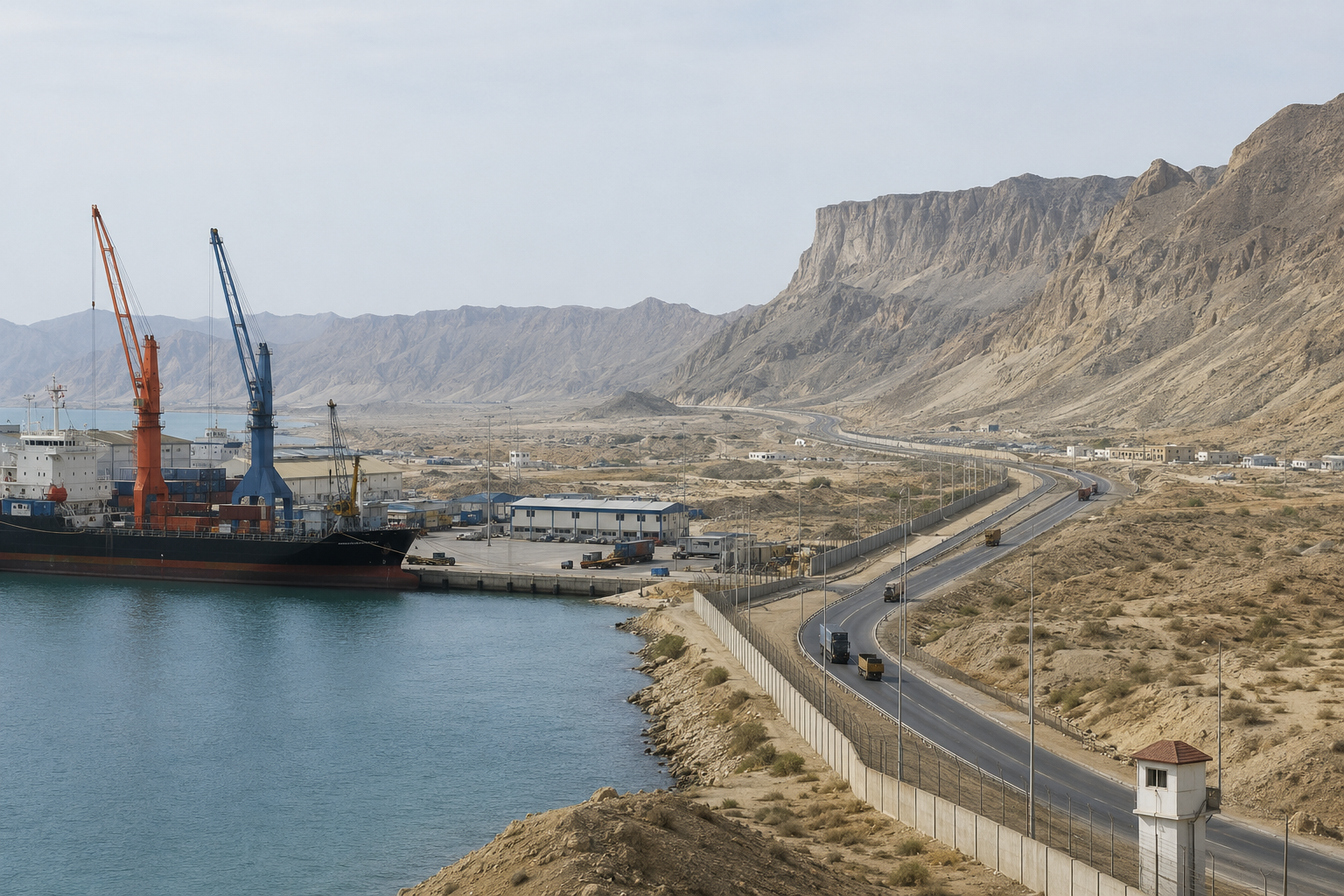
India has already withdrawn personnel from Chabahar and prepaid the full $120 million it had committed for the Shahid Beheshti terminal, and begun arranging to hand its operating stake to a local Iranian entity. The US sanctions waiver that had insulated the project lapsed on 26 April 2026. Meanwhile, Pakistan has formally activated Gwadar as a transit hub for third-country cargo to Iran through Statutory Regulatory Order 691 on 25 April 2026, the day before the waiver expired. But the corridor runs through Balochistan, where the insurgency is worse than it has been ever before. On 12 April, a Balochistan Liberation Army (BLA) naval unit struck a Pakistan Coast Guard vessel near Jiwani, the first confirmed maritime attack of its kind against the corridor. This article looks at where the shift leaves the three stakeholders caught up in it.
Pakistan and The Balochistan Chokepoint
Every overland route activated under SRO 691 runs through Balochistan, the Pakistani province where the state’s writ is weakest and where the Balochistan Liberation Army has expanded its operational reach in ways that should worry every actor with cargo moving through it. The Islamabad-based Pak Institute for Peace Studies recorded 254 militant attacks in Balochistan in 2025, a 26 percent rise on the previous year, with 419 killed. ACLED’s December 2025 reporting found that IED and grenade attacks on convoys and police stations had grown by more than 65 percent in the first eleven months of 2025 over the same period in 2024. Then, on 31 January 2026, the BLA launched coordinated strikes across multiple Balochistan cities at once including Gwadar, Quetta, Mastung, Panjgur, Dalbandin and others as part of their Operation Herof Phase II. Those are also the cities through which SRO 691’s six corridors pass.
What is more concerning is that BLA now operates a drone unit, announced in February 2026, and a naval wing it calls the Hammal Maritime Defence Force. That wing carried out the 12 April attack near Jiwani and it is the first time the corridor has been struck from the sea. On 24 May, a suicide car bombing claimed by its Majeed Brigade struck a train carrying security personnel and families near Quetta, killing dozens. It seems BLA is now running a multi-domain campaign aimed squarely at the assets of the corridor like ports, coastal patrols, military rail, and urban logistics nodes.
It is worth being clear that for Pakistan, this restructuring represents an opening as SRO 691 hands Gwadar its clearest commercial mission since it was built, converting a port long criticised as an underused strategic vanity project into a working transit hub with a duty-free land route to Iran roughly two to three hours from the border. For Islamabad, this is the long-sought identity shift from frontier state to connective bridge between South Asia, the Gulf, and Central Asia. Therefore, BLA now threatens the entire premise on which Pakistan is staking its regional economic future and the problem extends well past Pakistan and has turned into a regional security issue as Iranian importers face supply uncertainty every time an attack closes Gwadar.
India, Afghanistan, and the Loss of Alternatives
Chabahar was never one option among several as India invested in this corridor specifically to avoid Pakistan. Years before the current crisis, Delhi had tried routing its Afghan and Central Asian trade through Pakistani territory and found it unworkable. As the Indian commentator noted in the interview, Pakistan was charging heavily and cooperating little, and India eventually decided it was not worth the trouble. Chabahar Port was the answer to it as it directly linked India to the International North-South Transport Corridor (INSTC), which provided a secure, alternative route via Iran to ship goods to Afghanistan, Central Asia, and onward to Russia and Europe without relying on Pakistani land corridors.
Although India has now stepped away from Chabahar, the port has not closed, and Iran still operates it. But India’s transfer of its stake to an Iranian entity does not mean trade through Chabahar can simply continue. When Washington revoked the waiver, the State Department warned that those who operate Chabahar or engage in other activities there could expose themselves to sanctions under the Iran Freedom and Counter-Proliferation Act, and companies were left to exit the port and/or risk having US assets frozen and US transactions barred upon continued trade. It means India now has no western route that avoids both Pakistan and Iran. Nor is the new Gwadar corridor any kind of fallback, since the transit order does not extend to Indian-origin goods.
Having transferred its $120 million financial commitment, New Delhi retains both the legal framework of its 2024 ten-year agreement and a clear interest in returning, but re-entry now depends on several things that India cannot drive from the front. It waits on a working arrangement between Washington and Tehran, on India’s own tariff negotiations with a US administration that has threatened steep penalties on countries trading with Iran, and on a region in which Pakistan, of all states, has positioned itself as a mediator between Washington and Tehran. Even if the sanctions were to be lifted, Gwadar compromised by sustained insurgency would mean Chabahar reopens in name before it becomes functional in practice.
On the other hand, Afghanistan’s exposure is narrower than it appears. The country borders Iran and the Central Asian states directly, therefore, it needs neither Chabahar nor any Pakistani route to reach them, and it has been shifting its trade toward Iranian and Central Asian routes for months, with commerce through Iran now outpacing trade with Pakistan. What it cannot do is reach India, its other major trading partner, without crossing Pakistani territory, given the border closures with Pakistan that began in October 2025 ran past a hundred days, and they sit on top of a far older dispute in which Islamabad has long accused Afghan traders of using the transit-trade regime as cover for smuggling that undercuts Pakistani industry. That situation is now further narrowed by an open conflict with Pakistan since late February 2026. The UN has recorded at least 372 Afghan civilians killed in the first three months of the year, which is its highest quarterly figure since 2011, and the ceasefire China brokered in the weeks after was not fully held. Afghanistan’s fate now rests on whether India can recover Chabahar at all, and how the Balochistan insurgency and the US-Iran war play out around it. With all the uncertainty around this, Afghanistan is now left leaning harder on Iran, on Central Asia, and on an eventual overland link to China through the Wakhan corridor.
Conclusion
The western edge of South Asia is now shaped almost entirely by external actors. With that, three things follow. First, the corridor’s viability is now a security question before a commercial one, which means Gwadar’s future belongs as much to those tracking the Balochistan insurgency as to those modelling trade volumes. Second, treating India’s path back to Chabahar as a matter of waiting out the sanctions environment understates how much it depends on Washington, Tehran, and Islamabad rather than Delhi. Third, each state is also learning that the safer bet is to build its own way out rather than to build anything jointly through this reorder. Afghanistan is already chasing routes through Iran, Central Asia, and eventually China to cut its dependence on Pakistan. India, alone among the three, has no alternative route to fall back on, unless it moves toward a recalibration of its relationship with Pakistan, a prospect that, for now, remains politically improbable.