
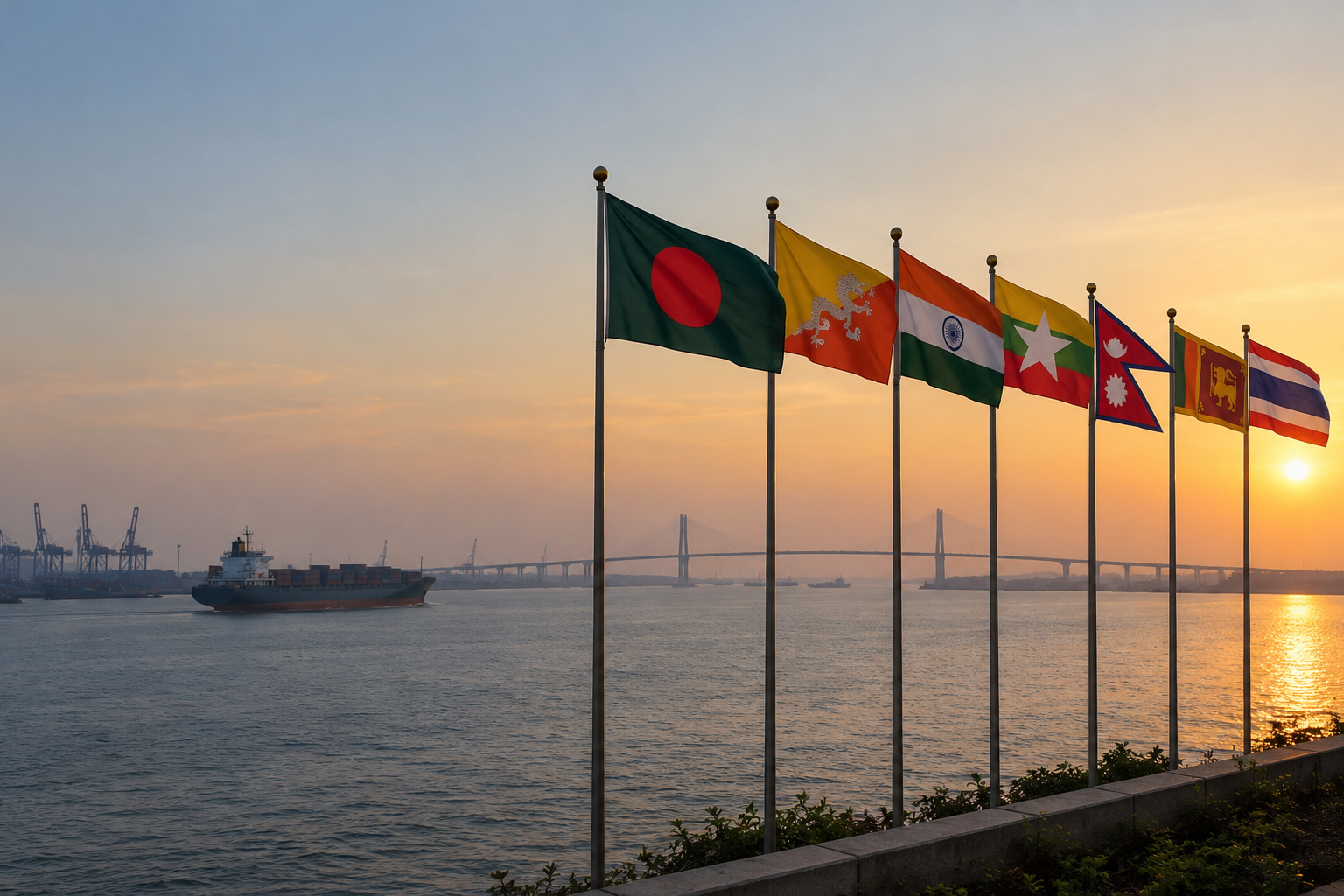
The prolonged inertia of the South Asian Association for Regional Cooperation (SAARC), primarily owing to the continuing political disagreements between India and Pakistan, has led to a renewed interest in other regional frameworks. Of these, the Bay of Bengal Initiative for Multi-Sectoral Technical and Economic Cooperation (BIMSTEC) has become increasingly strategically significant through the rising diplomatic involvement of India in the organisation and its focus on connectivity, maritime security, disaster management, and counter-terrorism, in line with its Neighbourhood First and Act East policy. This paper argues that the increasing interest of India in BIMSTEC could be part of the move toward a more functional and issue-driven regional cooperation. Rather than directly questioning if BIMSTEC could replace SAARC in the region, the paper investigates whether the functional approach in regional cooperation can be resilient in the face of political challenges in the membership of BIMSTEC. In light of some political changes in Bangladesh and Nepal, the paper analyses the resilience of functional regional cooperation and its possible implications for South Asian regionalism.
Executive Summary
- SAARC has struggled to deliver regional cooperation due to political disputes, more importantly, the constantly volatile India-Pakistan tensions have significantly hindered consensus-based decision-making and implementation within the organisation.
- BIMSTEC is a potentially more resilient model of functional cooperation but still not completely isolated from political realities. Its growing institutional and security focus provides for more opportunities for functional cooperation that are less reliant on resolving all political differences between its member states.
- However, BIMSTEC remains exposed to political and domestic distress within its membership. The Rohingya crisis alongside the political upheaval in Nepal and Bangladesh demonstrates how irregular implementation and politics within member states can hinder the longevity of regional cooperation.
- The strategic environment further strengthens the need for a stable security framework. The Bangkok Summit, increased maritime security cooperation, and Indian strategic engagement demonstrate increasing institutional momentum, whereas the situation in Myanmar and China’s increasing regional presence highlight the security concerns BIMSTEC needs to address.
- BIMSTEC must focus on converging regional interests rather than seeking to resolve broader political differences. Regular Home Ministerial Meetings and cooperation on counter-terrorism, trafficking, maritime security and intelligence-sharing would enable BIMSTEC to address cross-border security threats under its current functional scope.
- BIMSTEC should establish timelines, periodic reviews and focal points at the national level for better connectivity, energy and trade initiatives thereby ensuring that they remain unaffected due to any bilateral disputes or change of government.
Introduction
South Asia offers immense possibilities for regional cooperation; however, the current regional structure of South Asia has not been able to capitalise on that. The regional cooperation in South Asia has largely been determined by the relationship between India and Pakistan. The South Asian Association for Regional Cooperation (SAARC), formed in 1985 for the purpose of regional cooperation in South Asia, has not held any Summit meetings since 2014. While the stagnation of SAARC cannot be wholly blamed on ever-changing India-Pakistan relations, continuing bilateral disagreements have certainly hampered an organisation whose decision-making depends on consensus. In such a scenario, the Bay of Bengal Initiative for Multi-Sectoral Technical and Economic Cooperation (BIMSTEC), founded in 1997 has become increasingly strategically relevant. Made up of Bangladesh, Bhutan, India, Myanmar, Nepal, Sri Lanka, and Thailand, BIMSTEC links South Asia and Southeast Asia together, and has cooperated on connectivity, security, trade, disaster management and climate change issues. This is all the more pertinent in light of the increasing need for South Asian countries to cooperate on issues such as connectivity, maritime security, transnational crime, and others that the current regional frameworks have failed to adequately tackle.
In this regard, India has been very proactive: It leads the security component of BIMSTEC and has advocated cooperation in counterterrorism, disaster management, and energy security. However, BIMSTEC should not be seen as the direct alternative to SAARC. While SAARC is inclusive and has an all-encompassing agenda, BIMSTEC is small in size with a Bay of Bengal focus and functional cooperation.
The article thus analyses whether the functional approach of BIMSTEC is able to endure political volatility and bilateral differences between the states comprising the organisation. In light of BIMSTEC’s increasing role in tackling economic and security issues in the region, the central policy issue that needs to be considered is whether the functional approach of the organisation can survive political pressures from among its members. BIMSTEC may prove better at facilitating cooperation than SAARC, but only if political disagreements do not overwhelm its functional agenda.
Why Has SAARC Stalled?
The South Asian sub-continent can be considered as one of the most under-integrated parts of the world considering its geographic vicinity and economic interdependence among the member states. Only about five to six percent of South Asia’s trade comes from intra-regional trade, which is significantly lower than that in Southeast Asia and Europe. Therefore, poor efficacy of regional organisations in South Asia becomes extremely important, because the sub-continent has high prospects for connectivity and economic integration, but political differences constantly hinder the fulfilment of the potential.
SAARC, created back in 1985, aimed to fill this gap. However, the institution’s structure made it very prone to political disagreements between its member states. SAARC operates on consensus, and bilateral issues are not included in the agenda of the organisation. As a result, when the situation between India and Pakistan gets worse, cooperation becomes impossible. It can be seen from the example of the 2016 SAARC Summit in Islamabad that was indefinitely postponed due to the refusal of India and other states to participate in it. Additionally, SAARC has developed agreements and institutions, such as the South Asian Free Trade Agreement (SAFTA), which were not implemented effectively. Even though its aim was to reduce barriers to trade within the region, SAFTA has resulted in very few changes in trade between India and Pakistan, since political differences have led to tariffs and non-tariff barriers, along with institutional deficiencies, cumbersome documentation procedures, and poor infrastructure which acted as additional factors that prevented implementation of the treaty. This gap between institutional promise and implementation has reinforced a trend of states relying on bilateral and sub-regional solutions.
Why Does BIMSTEC Appear Different?
Against the backdrop of SAARC’s stagnation, the Bay of Bengal Initiative for Multi-Sectoral Technical and Economic Cooperation (BIMSTEC) started receiving increased attention. Unlike SAARC, it excludes Pakistan from its membership whereas Thailand acts as an additional significant regional power outside South Asia. BIMSTEC’s geographical and strategic orientation makes it different from SAARC rather than its institutional alternative.
The key strength of BIMSTEC is its functionally oriented policy-making. Areas covered by BIMSTEC include trade and investment, transport and connectivity, energy, disaster management, climate change and counterterrorism. In this case, cooperation on matters of common interest becomes possible without a need to reconcile all other political differences among states. Moreover, India’s increasing involvement has provided the organisation with additional impetus through its projects on energy, business cooperation, transport connectivity and security. However, BIMSTEC’s functional nature does not render it exempt from political pressures. For instance, the BIMSTEC Free Trade Area initiative was concluded in 2004, but has yet to be implemented, while the organisation’s Secretariat has been struggling due to resource problems. The comparison therefore presents a complex scenario whereby SAARC illustrates how political disagreements can paralyse regional institutions whereas BIMSTEC exemplifies the potential of functional collaboration.
However, the institutional benefits offered by BIMSTEC have not yet been converted into consistent regional integration. Its experience with the delayed Free Trade Area, low levels of intra-regional trade and implementation makes it evident that a good design is a good start for ensuring collaboration, but does not guarantee immediate success.
The 2025 Bangkok Summit: From Ambition to Implementation?
The Sixth BIMSTEC Summit in Bangkok on 4 April 2025 saw an effort on the part of the organisation to transition from general statements to an institutional approach to cooperation. Specifically, the Summit endorsed the BIMSTEC Bangkok Vision 2030, the first vision document of BIMSTEC, adopted the Rules of Procedure for BIMSTEC mechanisms, as well as a report of the Eminent Persons Group on the future development of BIMSTEC. At the same time, the Summit adopted the Maritime Transport Cooperation Agreement and endorsed partnerships with the Indian Ocean Rim Association (IORA) and the United Nations Office on Drugs and Crime (UNODC). The importance of such decisions, however, does not reside in the quantity of agreements, but rather in the fields of cooperation that BIMSTEC is trying to institutionalise. All maritime transport, trade, disaster management, security and digital infrastructure deal with practical cross-border problems that require coordinated efforts by the states involved.
India’s role is especially crucial in this context. India has put forward various initiatives on disaster management, maritime transport, digital public infrastructure, youth training, space cooperation, and economic integration, including BIMSTEC Chamber of Commerce and annual BIMSTEC Business Summit. These initiatives suggest that while India is engaged in BIMSTEC in terms of diplomatic support for the group, it is now also contributing to building institutions and capabilities inside the organisation. However, the Summit revealed the main problem with the functional approach used by BIMSTEC: while the ambition to implement various initiatives and projects was there, the implementation itself was lacking. Bhutan’s Prime Minister Tshering Tobgay noted that after almost three decades of its existence, the work of BIMSTEC could be described as “incremental at best”. In particular, its Free Trade Area project had made no progress.
The Bangkok Summit therefore paints a picture that is more complex than simply being a success story. While BIMSTEC has become more institutionally coherent and has a larger program of cooperation at its disposal than before, its credibility will be determined by the ability of these initiatives to stand up against the political divisions among its members. The Summit demonstrated that BIMSTEC has the institutional capability to engage in functional regionalism, but the real issue is whether it has the political solidarity to sustain it.
China and the Strategic Security Dimension
BIMSTEC’s growing security relevance must be viewed in light of the increasing Chinese footprint in the Bay of Bengal and the broader Indian Ocean. China’s security relations with both Bangladesh and Sri Lanka have been developing, and the People’s Liberation Army (PLA) Navy has increased its operations in the Indian Ocean region (IOR) .For India, these changes have added to BIMSTEC’s strategic importance, not only in terms of economic cooperation but more importantly as a multilateral platform for securing maritime security and intelligence collaboration within the Bay of Bengal countries.This provides BIMSTEC with strategic importance for India besides economic cooperation because it allows the creation of a multilateral framework within which intelligence-sharing, maritime security and “cooperative security” can be enhanced amongst the Bay of Bengal countries.
China’s increased economic engagement and construction of infrastructure in the Bay of Bengal may have strategic ramifications, especially when ports and transport infrastructure gain dual use thereafter, raising concerns over the region’s strategic balance and security of sea routes. Thus, the presence of China in the IOR creates a broader security rationale for a more effective BIMSTEC. However, this does not make the organisation an anti-Chinese security arrangement. On the contrary, the increasing footprint of China in the region enhances the need for a regional framework within which India can develop security cooperation with its neighbors in a multilateral manner. Recent initiatives in the area of maritime security cooperation by BIMSTEC, including work on Maritime Domain Awareness, Maritime Law Enforcement cooperation and a planned Multilateral Maritime Security Exercise to be held in the latter half of 2026, strongly indicate the growing importance of the security dimension.
This demonstrates why India’s engagement with BIMSTEC must be seen as much more than a strategy to simply compensate for SAARC’s stagnation. India’s geographical position underscores its strategic need for better connectivity with Bangladesh and Myanmar and integration of India’s northeastern states into Bay of Bengal and South Asian transport networks. Such connectivity could help reduce the reliance of the Northeastern provinces on the narrow land connection in mainland India, improve access to ports and regional markets, and strengthen India’s broader Act East and Indo-Pacific engagement. Simultaneously, a more robust BIMSTEC framework would provide New Delhi with a platform to engage with states that are increasingly being influenced by China.
The challenge, however, is to ensure that this new strategic rationale does not transform BIMSTEC into a tool of great-power competition at the expense of functional cooperation that creates comparative advantage for the organisation. In this context, it would be erroneous to interpret the increasing strategic significance of BIMSTEC as a sign of completed regional integration as many of its present-day achievements are attributable to the congruence of Indian interests with the SAARC vacuum.
The Rohingya Crisis: BIMSTEC’s Security Challenge
Since 2017, the forced displacement of more than 700,000 people from Myanmar into Bangladesh has resulted in effects going well beyond the humanitarian domain, and has included trafficking, irregular migration, and insecurity in the Bay of Bengal. With Bangladesh still housing one million refugees and conditions in Myanmar’s Rakhine state remaining volatile, the Rohingya crisis is gradually becoming an issue of regional security.
BIMSTEC has structures for collaboration in the domains of counterterrorism and transnational crimes, including human trafficking, and in recent years, efforts have been made to increase regional security cooperation. In July 2026, BIMSTEC Secretary General Indra Mani Pandey advocated the need to institutionalise Home ministerial meetings and develop an action plan for counterterrorism and human trafficking by the organisation.
The situation is even more complex in Myanmar since the ongoing internal conflicts in the country have introduced cross-border threats to neighboring member countries.This challenge is further exacerbated by the fact that Myanmar’s security institutions are functioning within the context of a military regime in the midst of a civil war. Due to the 2021 military coup, continuous fighting involving the military against several resistance and armed ethnic groups has caused major displacements, insecurity at the border and organised criminal activities. All of these situations directly impact the region around the Bay of Bengal, through trafficking, illicit activities and maritime insecurity. The internal conflict has resulted in a rise in illicit networks related to drugs, weapons, and human trafficking, and the instabilities in Myanmar have posed dangers not only to India and Bangladesh but also to the maritime regions of the Bay of Bengal. The significance of the geographical location of Myanmar is noteworthy in this respect since it occupies a central position in the Golden Triangle region and there has been a considerable increase in the production and trafficking of drugs across the India-Myanmar border. This issue directly poses a challenge to the role that BIMSTEC wants to play in terms of enhancing regional security cooperation, especially considering the fact that the very country that BIMSTEC hopes to work with is currently experiencing protracted armed conflicts.
Nonetheless, BIMSTEC has continued engaging with Myanmar in its security agenda: In a June 2026 speech, the BIMSTEC Secretary-General referred to Myanmar as essential for regional security cooperation regarding organised crimes, terrorism and maritime security, while in one of the meetings in July 2026 , BIMSTEC National Security Chiefs decided to include Myanmar along with other member states in discussions on organised crime, terrorism, maritime and other emerging security threats. Additionally, the 7th BIMSTEC Sub-Group Meeting on the Prevention of Illicit Trafficking in Narcotic Drugs, Psychotropic Substances and Precursor Chemicals held in Chiang Rai, Thailand, in December 2022 involved the participation of delegates from all BIMSTEC countries in deliberations over the preparation of the BIMSTEC Plan of Action on Drug Control. Although there was no indication of a fixed deadline for the plan, the conference highlighted the need for intelligence sharing among BIMSTEC members in order to effectively manage narcotic drugs in the region.
Yet, Myanmar continues to expose the limitations of BIMSTEC’s functional model. In July 2026,Pandey stated that the Rohingya crisis is out of scope for BIMSTEC because its agenda does not cover political problems at the moment. Despite the institutional consistency of the position, the contradiction becomes apparent between the growing agenda of regional security in BIMSTEC and reality because the refugee situation cannot be divided strictly into ‘political’ aspects as it results in transnational crimes and trafficking, and maritime security issues. Myanmar thus poses a two-pronged problem to BIMSTEC: both as a member whose involvement is necessary for security cooperation within the region and as a threat to the region emanating from transnational issues.
Therefore, the real question here is not about whether BIMSTEC should mediate politically in the case of Myanmar. Rather, it could use its functional capacities to deal with the spillover effects of the crisis such as trafficking, intelligence gathering, maritime security and humanitarian assistance, while political mediation and repatriation should be left to diplomacy.
The Rohingya problem is an example of the potential and limitations of the functional approach of BIMSTEC. The functional approach facilitates cooperation between states without the need for a consensus in all political disputes, but the problem becomes more complicated when a politically controversial issue generates regional security implications. The reaction of BIMSTEC to the Rohingya problem will reveal whether the growing security architecture of the organisation can continue to be relevant in the light of regional security issues that cannot be resolved through a technical approach.
Bangladesh and the Limits of Functional Insulation
Bangladesh plays a crucial role in BIMSTEC as one of its founding members, hosts its Permanent Secretariat, and acts as the Lead Country for Trade, Investment and Development. Its geographical location makes Bangladesh a good candidate for acting as a bridge between South and Southeast Asia. In terms of the sectoral structure of BIMSTEC, Bangladesh is the leader in the Trade, Investment and Development sector, thus making economic integration the main priority of its participation in BIMSTEC. The authorities of Dhaka have constantly been calling for implementation of already made decisions of BIMSTEC, including the creation of the BIMSTEC Free Trade Area, energy grid connectivity and other institutional structures that would ensure the realisation of decisions made during summits. However, there still remains a difference between ambition and realisation.
Connectivity provides a case in point. While the transport initiative of BIMSTEC seeks to connect its landlocked and littoral members through road and rail connectivity, physical infrastructure alone does not lead to integration. Trade among members of BIMSTEC is minimal (accounting for approximately 6.15 per cent of member countries’ total trade), despite prolonged discussions on the Free Trade Area. The connectivity initiative of the organisation also encounters challenges of non-tariff barriers, varying standards and inadequate infrastructure. Thus, harmonised customs processes, interoperable logistics systems and regulation still play a key role in making the connectivity vision of BIMSTEC a reality, especially for Bangladesh, which has great potential for being a regional hub due to its geographical location.
The case has become more significant following Bangladesh’s political transition after the ousting of Sheikh Hasina in August 2024. However, the following February 2026 election saw the return of the Bangladesh Nationalist Party (BNP) to power with Tarique Rahman at the helm, thus making another change in Bangladesh’s leadership. This transition will serve as a crucial test of BIMSTEC’s institutional resilience. Rather than simply assuming that political change will hinder regional cooperation, the continuity of Bangladesh’s role as host of the Secretariat and its renewed involvement in BIMSTEC will reveal whether institutional commitments can survive changes in government. The renewed commitment, reiterated by Rahman on BIMSTEC Day in June 2026, indicates that a change in government has not, at least at the institutional level, altered Bangladesh’s commitment to the organisation. The deteriorating relations between India and Bangladesh, owing to disputes over Hasina’s presence in India, and other border issues have added to the political risk in the most important relationship for the purposes of BIMSTEC’s cooperation agenda. This example demonstrates how BIMSTEC can identify its shared interests without necessarily resolving all the bilateral differences; however, the need for political engagement by the countries involved cannot be overlooked. This shift from Sheikh Hasina’s government to that of the BNP clearly shows both sides of the problem faced by BIMSTEC, whereby its structures may ensure continuity in cooperation despite regime changes, provided that succeeding regimes are committed to implementing regional decisions.
Nepal and the Problem of Political Volatility
Nepal presents yet another difficulty for BIMSTEC: internal political instability that may change the agenda and implementation capacity of its member country. Political developments of 2024-25, including the fall of K.P. Sharma Oli’s government following the youth protests in September 2025, are evidence of this volatility. In his speech at the 2025 BIMSTEC Summit, Oli stressed the need to implement the BIMSTEC Master Plan for Transport Connectivity and the Maritime Transport Cooperation Agreement on a time bound basis. While regional coordination could help establish priorities, the success of these priorities will be contingent upon the governments’ ability to maintain enough political stability and administrative capacity. Post Oli’s resignation, Balendra Shah took office as the Prime Minister of Nepal in March 2026, which brought about a new era of politics focusing on connectivity and digital networks. During his BIMSTEC Day speech delivered in June 2026, Shah reiterated that Nepal is committed to BIMSTEC with a focus on transport, trade and digital connectivity along with the implementation of regional cooperation. The fact that this commitment has continued despite a change in government demonstrates that political changes need not interfere with BIMSTEC cooperation, however, it implies the need for institutional frameworks to preserve such commitments across different governmental regimes.
Nepal’s location between India and China is yet another factor. Kathmandu needs to have good relations with both countries, while the export of hydropower to India and future exports to Bangladesh show the possibility of economic interdependence through BIMSTEC.
Nepal is therefore, a case in point to understand a key problem facing BIMSTEC’s functional approach: it may move ahead despite all political conflicts, but not without adequate capability at home.
Policy Recommendations
- Institutionalise BIMSTEC’s security coordination: The Home Ministers’ mechanism of BIMSTEC has never had a consistent institutional framework before, because the process of cooperation in security matters took place through the Joint Working Group on Counter-terrorism and Transnational Crime . Moreover, there was never a mechanism for the Home Secretaries or the Home Ministers. Thus, there is an urgent need for the BIMSTEC members to develop an annual Home Ministers’ forum along with a functional mechanism to tackle counter-terrorism and transnational crime within the next 12 months.
This can be put into action by ensuring that the Home Ministerial meetings are incorporated into the schedule of the Permanent Working Committee and preparatory meetings are set up at the level of Home Secretaries or National Security Chiefs for the development of agenda, coordination of intelligence and review of counter-terrorism mechanisms in place. India, being the lead country of the security pillar, can take up the responsibility of hosting the meetings and setting up standard operating procedures, and the Home Ministerial meetings shall be associated with the existing Joint Working Group on Counter-Terrorism and Transnational Crime and its subordinate groups. This mechanism should leverage the existing framework of BIMSTEC by developing a structure for information exchanges and sharing among designated national points for issues such as trafficking, organised crime and irregular border crossings.
The need to develop a formal mechanism emanates from the fragmented nature of the existing framework of security cooperation of BIMSTEC and lack of a strong formal Home Ministers’ forum. Implementing these arrangements would give BIMSTEC’s existing commitments a permanent channel for implementation rather than solely relying on declarations and ad-hoc meetings.
- Create a standing regional arrangement for the spillovers from the Rohingya crisis: The main difficulty here lies in the current stance of BIMSTEC on the political nature of the Rohingya crisis which is not under its mandate. It is recommended that BIMSTEC entrust its security mechanisms to formulate a dedicated response strategy in response to the spillover effects of the Rohingya crisis without any expansion of the mandate of the organisation into political mediation.
One way BIMSTEC could control the effects of the crisis is through leveraging its existing security and transnational crime apparatus for information sharing and coordination regarding human trafficking and illegal migration, as well as increased maritime surveillance of the Bay of Bengal. The first step towards achieving this can be to initiate the formulation of a regional framework of action from within the BIMSTEC Secretariat and relevant security agencies, with Bangladesh, Myanmar, India, and Thailand being the main actors involved. The Secretariat, in cooperation with Bangladesh and Myanmar within one year, can map the key spillover effects (human trafficking, irregular maritime migration, and organised crime, for example) and create agreed upon information exchange mechanisms and joint responses in case the situation escalates, to make sure that regional preparedness is enhanced without making BIMSTEC mediate politically.
- Safeguard functional economic and connectivity projects from bilateral frictions: The biggest challenge for BIMSTEC still lies in successfully implementing its commitments at a national level. The organisation’s current framework continues to depend largely upon political and administrative commitment of the participating states, the aim must be to improve implementation mechanisms rather than rely on political commitments.
BIMSTEC can safeguard ongoing connectivity, trade and energy initiatives from disputes between countries by shifting from consensus at an individual project level to implementation of the project at the sub-regional level. The BIMSTEC Transport Connectivity Working Group (BTCWG) and focal points of the member states must be charged with the identification of those projects that can be implemented within the willing member states along with timelines and annual reviews to be shared in the Ministerial Meeting. In this way, projects could go ahead despite any lack of consensus in the entire BIMSTEC region due to political issues between the member states. This strategy is especially applicable to BIMSTEC’s Master Plan for Transport Connectivity (2018-2028), the implementation of which is currently being done through the BTCWG and involves the Senior Officials’ and Ministerial meetings for approval.
The BIMSTEC Secretariat, in cooperation with national focal points in each member country, should develop standard timelines and annual progress assessments for all significant regional projects. Every project must have its implementing authority in the member country, timeline of implementation, and system of notification for delays to be reported to the ministry concerned. Moreover, it must keep a publicly accessible implementation tracker for the projects, which includes the national authority responsible for implementation, deadline, progress and the reason behind any delay in implementation. Having one monitoring system will increase accountability for delays in implementation and decrease the chances of disruption due to bilateral tensions and political changes.
- Prioritise implementation before expansion: BIMSTEC must concentrate on fulfilling the current commitments of the organisation before venturing into new areas of work. The Secretariat and the responsible countries in relation to the various initiatives must provide clear time frames and designate specific agencies within their respective governments to the organisation’s initiatives, based on the seven main pillars of the organisation. Rather than creating new commitments, the focus must be on developing the existing frameworks like the BIMSTEC Free Trade Area and Master Plan for Transport Connectivity.
At the next BIMSTEC Summit, member nations should focus on a few key projects in areas such as connectivity, maritime transportation, trade facilitation, energy and disaster management and set up quantifiable targets for their implementation before embarking on any other significant projects. The progress made should additionally be reviewed every year by the respective ministerial committees and the results should be published by the Secretariat. This becomes necessary since the main institutional weakness within the organisation is not the lack of statements but the poor transformation of the commitments into achievements, as has been seen in the case of the Free Trade Area.
Conclusion: Can Functional Regionalism Withstand Political Stress?
BIMSTEC’s long-term success is conditional: its functional model certainly provides a greater scope for sustained cooperation but only if the member states can prevent political hindrances from disrupting its implementation. The issue is not in the absence of diplomatic efforts as institutional dynamics have been evident through consistent ministerial interaction and an increasing organisational framework. Rather, its major limitation remains the contradiction between its political commitments and implementation.
The Rohingya and Myanmar cases further indicate that BIMSTEC’s functional approach often faces the bigger challenge when political conflict is entwined with security threats. Additionally, the problem of China’s growing regional presence underscores the strategic importance of enhancing regional security cooperation.
The Indian factor adds another dimension to this equation. The Government of India has staked political capital in BIMSTEC and has begun utilising it as a vehicle for cooperation in terms of connectivity, security and intelligence sharing. The sustainability of its approach will thus rely on how India’s investments contribute to building collective institutional capacity without making BIMSTEC too dependent on one particular country’s strategic interests.
The evidence appears to suggest that the strength of BIMSTEC is therefore not in its ability to avoid political interference but rather in its capacity to manage the disruptive impact of politics through a functional approach. However, the Bangkok summit indicates institutional dynamism, whereas the Rohingya crisis, political upheaval in Bangladesh and Nepal simultaneously demonstrate the vulnerability of this model.
It is possible, then, for BIMSTEC to offer a more durable framework for regional cooperation than SAARC, but this does not mean that it is entirely free from the political dynamics that characterised its predecessor. Much still depends on the member states to prove that they can work together in their common interests, such as connectivity, maritime transport, energy, disaster management, and trade facilitation without being disrupted by any bilateral disagreements, changes in domestic politics and broader strategic competition. These recommendations have been made to overcome the coordination and implementation gaps mentioned above, while maintaining the functional emphasis that is the comparative strength of BIMSTEC. If it manages to turn its increasingly institutionalised and security-oriented agenda into concrete results, it could emerge as a good example of issue-based regionalism in South and Southeast Asia. Hence, BIMSTEC’s comparative advantage will not solely depend on whether it can escape regional politics but whether it can prevent political disruptions from undermining regional cooperation where common interests still remain.