Most commentary on the Reciprocal Exchange of Logistics Support (RELOS) agreement between India and Russia has focused on what it means for New Delhi’s relations with Washington, or on the symbolism of allowing a foreign military to station troops on Indian soil for the first time. These are legitimate questions. But they risk missing the more consequential story: that RELOS represents a deliberate attempt by India to institutionalise strategic reach into the Arctic, a region that South Asian security analysts have largely ignored, but which is fast becoming one of the most contested theatres in great-power competition.
What the Agreement Does and Does Not Do
Signed in Moscow on 18 February 2025, ratified by Russia under Federal Law No. 458-FZ on 15 December 2025, and formally entering into force in January 2026, the agreement allows both sides to station up to 3,000 troops, five warships, and ten aircraft in each other’s territory at any given time. That headline figure has generated significant commentary. A more sober assessment, however, is offered by Aleksei Zakharov of the Observer Research Foundation (ORF), argues that RELOS signals continuity rather than a strategic breakthrough, with its primary focus on facilitating bilateral engagements during exercises, and with any port call still requiring case-by-case coordination. Rahul Bedi’s analysis reinforces this, noting that RELOS was intentionally kept low-profile by New Delhi and framed as routine housekeeping, a calculated device to pre-emptively bypass potential Western sanctions while preserving the continuity of India-Russia defence cooperation. RELOS is not an alliance commitment. What it does is institutionalise a logistics relationship that previously operated on an ad hoc basis, and the geography of what it institutionalises is where the strategic significance lies.
Former Indian Ambassador to Russia Ajai Malhotra, speaking to Al Jazeera, described the agreement as marking a move from an equipment-centric defence supply relationship to one that also enables operational logistics cooperation, adding a functional layer of interoperability that India did not previously have with Russia, one that diversifies risk by allowing India logistics access outside Western-controlled networks. His framing – that this represents continuity deepened rather than an alliance formed, is the most analytically precise available
The Arctic Dimension
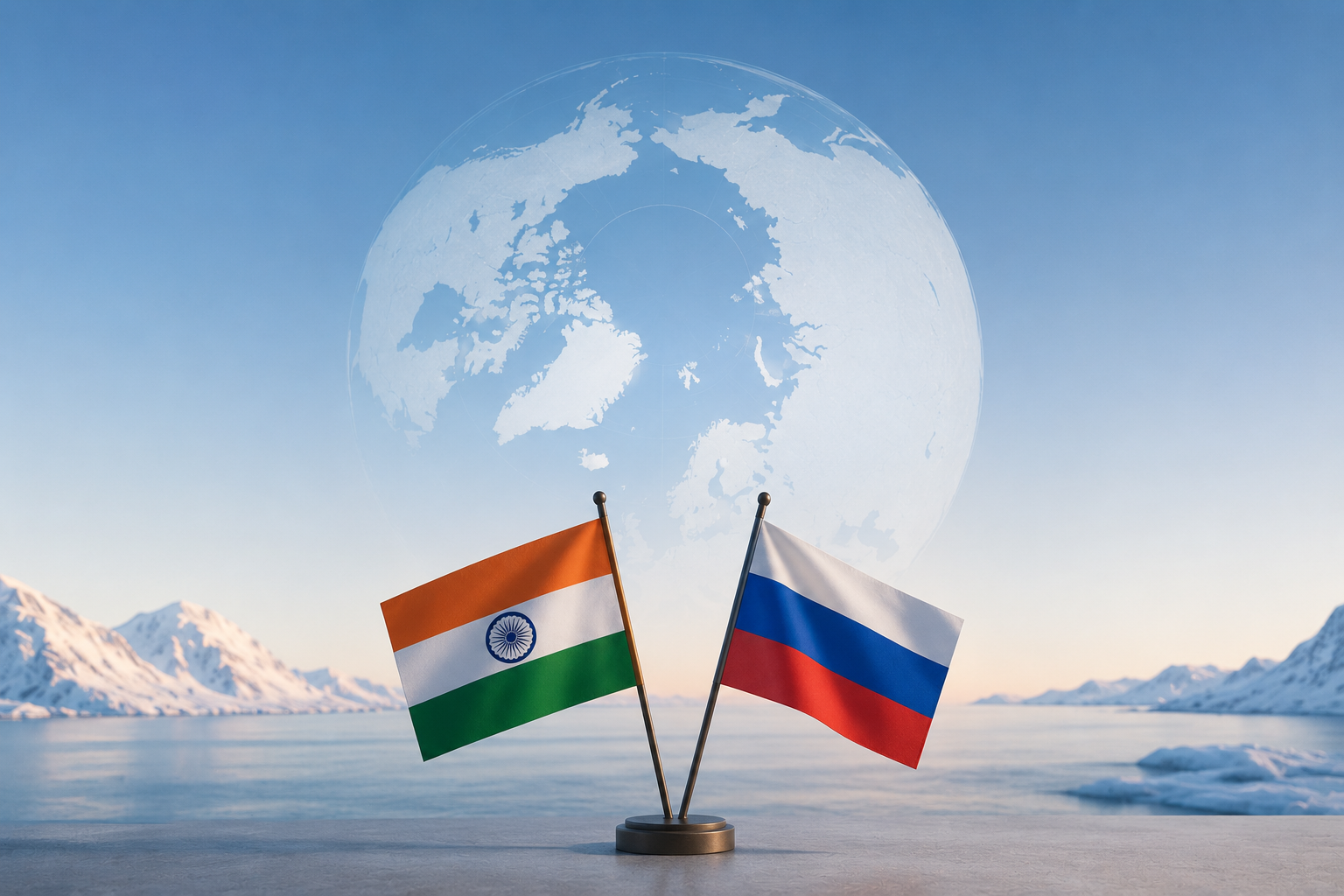
India already imports liquefied natural gas from Russia’s Arctic region, and RELOS now gives Indian naval and commercial vessels access to Russian Arctic ports, including Murmansk and Severomorsk for refuelling and repairs, with icebreaker escorts through frozen passages. Russian officials have indicated the pact may eventually give India access to more than 40 naval and air bases stretching from Arctic waters to the Pacific, while India and Russia also aim to integrate the Northern Sea Route with the International North-South Transport Corridor, a 7,200-kilometre multi-modal network connecting India to Russia via Iran and Central Asia.
This is the dimension that existing commentary has most significantly underweighted. India published its formal Arctic Policy in 2022, but as the Observer Research Foundation has noted, India’s collaboration with Russia on the Northern Sea Route reinforces its principle of strategic autonomy by offering an opportunity to
counterbalance China’s growing Arctic presence while protecting its energy supply lines. RELOS converts that aspiration into an operational capability, however nascent.
The driver is China. Beijing has invested approximately $10 billion in Russian Arctic energy projects, including the Yamal LNG pipeline and Arctic LNG 2, holding a 20 per cent stake, and its growing presence along the Northern Sea Route directly challenges India’s economic and geopolitical interests. India’s Arctic engagement with Russia is, in part, a hedge against being marginalised as China consolidates preferential access to Arctic shipping infrastructure. As Foreign Policy has observed, the China dimension compounds every element of India’s strategic calculus at this moment.
Multi-Alignment Under Pressure
RELOS does not exist in strategic isolation. It sits alongside India’s Logistics Exchange Memorandum of Agreement (LEMOA) with the United States, signed in 2016, and comparable arrangements with France, Australia, Japan, South Korea, and the United Kingdom. RUSI’s Vinay Kaura has described India’s simultaneous deepening of Quad commitments and sustained engagement with Russia as India seeking to remain the axis upon which the fragile equilibrium of the international order may yet depend, while noting that the danger is not simply American retaliation for India’s Russia ties, but the risk of being caught in a bilateral squeeze where any move toward one pole is interpreted as betrayal by the other.
That squeeze is tightening. 2025 was arguably the most difficult foreign-policy year for Prime Minister Modi since assuming office in 2014, a terrorist attack in Kashmir, a four-day conflict with Pakistan, a deterioration in India-US relations after Trump claimed credit for the ceasefire, and a deepening of US-Pakistan ties that New Delhi found deeply uncomfortable. In that context, RELOS also functions as a signal of retained options.
According to SIPRI data, India’s arms imports from Russia fell from 72 per cent of total imports between 2010 and 2014 to 36 per cent between 2020 and 2024, with France and the United States now collectively supplying 46 per cent of India’s military imports. India is simultaneously diversifying away from Russia in procurement terms while deepening institutional entanglement through RELOS, a deliberate strategy of managed dependency that carries compounding exposure if external pressure continues to harden.
The Wire’s analysis identifies the underlying logic clearly: RELOS’s emergence was rooted in concerns over possible US penalties on bilateral defence transactions, concerns given tangible form by India’s 2018 decision to acquire five S-400 systems, which prompted explicit warnings under the Countering America’s Adversaries Through Sanctions Act (CAATSA). Formalising logistics outside financial transaction channels reduces that exposure. It is, in that sense, a structural rather than simply a diplomatic response to the sanctions environment.
What This Signals for South Asian Security
The South Asian implications of RELOS deserve direct analytical attention on three counts.
First, the Arctic dimension matters for regional energy security in ways that have not been discussed. India’s access to Russian Arctic LNG and its stake in Northern Sea Route infrastructure directly affects the energy calculus of the wider South Asian neighbourhood. The Chennai-Vladivostok Eastern Maritime Corridor, operational since 2024, cuts travel time from over 40 days via Suez to around 24 days and is being considered for expansion to other Indian ports and Southeast Asian countries. As Arctic routes become commercially
viable, the ability to shape access to them, not simply use them. It becomes a strategic asset with downstream consequences for South Asian connectivity.
Second, the agreement’s signal to Pakistan is not negligible. Islamabad has watched India’s logistics network expand across the United States, France, Australia, Japan, and the United Kingdom. RELOS adds Russia at a moment of significant India-US friction and when US-Pakistan ties have deepened in ways New Delhi finds uncomfortable. The triangular dynamics between India, Russia, and Pakistan in the current moment deserve sustained analytical attention from South Asian security scholars.
Third, and most broadly, RELOS illustrates a pattern now characteristic of South Asian strategic competition: the bilateralisation of security architecture as a substitute for failing multilateral frameworks. Rather than relying on institutions, India is assembling a network of bilateral logistics agreements that preserves operational flexibility without formal alliance commitments. The ORF has noted that for India, the priority is ensuring that any agreement solidifying its partnership with Moscow does not disrupt progress in other relationships, a formulation that captures the essential tension precisely. Managing that tension, rather than resolving it, is the defining characteristic of India’s current strategic posture.
RELOS is, in the end, less a story about India and Russia than about how a major power navigates compounding pressures, sanctions exposure, great-power rivalry, energy insecurity, and expanding strategic ambition without foreclosing options. Whether that navigation remains sustainable depends on how much further the external pressure environment tightens, and whether the institutional habits generated by RELOS eventually constrain the very flexibility they were designed to preserve.