There is a specific mechanism connecting the legal fight over the Indus Waters Treaty to the growing possibility of an actual military incident, and most commentary on this subject misses it because it treats the two as separate stories. One story is about courts, articles, and jurisdiction. The other is about generals, ministers, and war talk. They are not separate. The legal deadlock is what created the space for the war talk, and understanding that sequence is the whole point of calling this hydrological lawfare in the first place. Lawfare, as used here, means the deliberate use of legal process rather than force to pursue a strategic or political objective.
The onset of Hydrological Lawfare
Start with the deadlock itself. When India put the treaty on hold on 23 April 2025, it did not end the treaty the way the treaty says it should be ended. Article 12 says both countries have to agree before anything changes. It does not let one side stop the treaty on its own. Pakistan took this point to the Permanent Court of Arbitration. On 27th June 2025, the court ruled that it still has the authority to hear the case. Pakistan’s foreign ministry said this confirmed the treaty was still valid and that no single country could suspend it on its own. India’s foreign ministry saw it differently. It said it had never recognised this Court as properly constituted in the first place, so nothing it decided could bind India either way. On 15 May 2026, the Court issued a further ruling limiting how much water India could hold back in its reservoirs. India rejected this ruling too, for the same reason as before, while Pakistan continued to treat the Court’s decisions as authoritative. Since then, neither government has really moved from its original position. Pakistan maintains that the Court’s rulings are binding; India maintains that the Court has no standing to bind it. It is this deadlock, not any single provocation on the river, that this piece classifies as hydrological lawfare.
Lawfare’s Institutional Vacuum
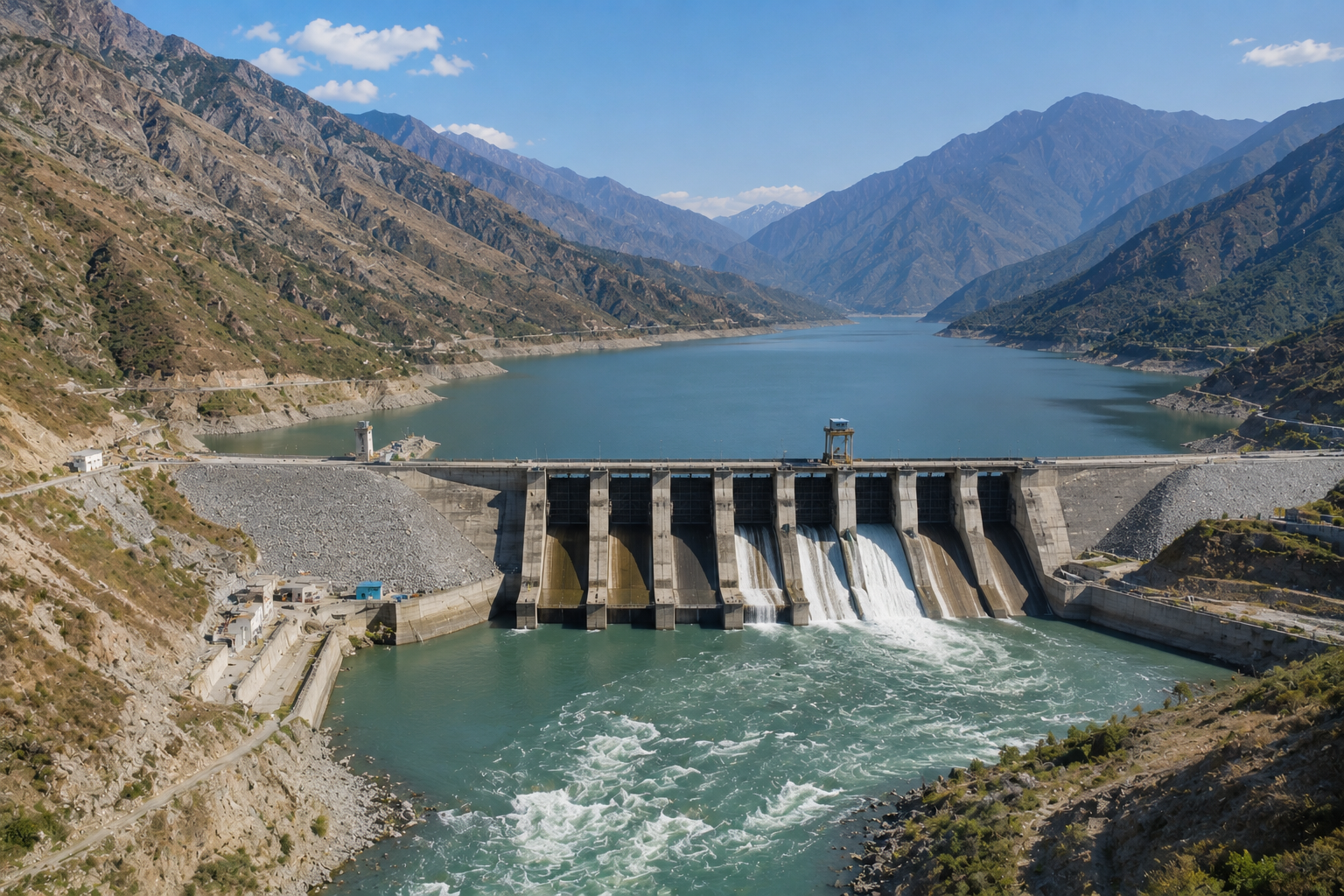
Here is why that matters beyond the courtroom. A functioning legal mechanism exists to absorb disputes so they do not have to be resolved through pressure or force. That is its entire purpose. Once India removed itself from that mechanism, Pakistan lost its only formal channel for making India answer for specific actions on the river, things like the abrupt flow variations on the Chenab that Pakistan has now raised through official channels several times since 2025. With no working court, no functioning Permanent Indus Commission, and no neutral expert process actively engaged, both governments were left with only one register to communicate in, which is public rhetoric aimed at their own populations and at international opinion.
The Narratives: New Delhi’s version
On the Indian side, the narrative does specific work. Describing the treaty suspension as inseparable from counterterrorism, as in Prime Minister Modi’s statement, made in the days after the April 2025 Pahalgam attack that killed twenty-six civilians, that water and blood cannot flow together, allows India to justify withholding water without ever having to defend that withholding as a legal act, because it has already been recast as a moral one. It also sets a bar for restoration, credible and irreversible cessation of terrorism, that has no clear definition and no clear endpoint, which means the treaty can stay suspended indefinitely without India ever having to say so directly. As India’s Ministry of External Affairs spokesperson put it in a July 2026 briefing, “the IWT stands in abeyance in response to Pakistan’s continued sponsorship of cross-border terrorism” and Pakistan “must credibly and irrevocably abjure its support for cross-border terrorism” – restating the same open-ended standard nearly a year after the treaty was first suspended.
Islamabad’s version
On the Pakistani side, the narrative does different but equally strategic work. When India suspended the treaty in April 2025, Pakistan’s government said any attempt to stop or divert its share of water would be considered an act of war. Language like this moves the dispute out of a technical or legal register and into one that sounds more urgent and immediate. This is also part of why Pakistan organised an international seminar in Islamabad at the end of June 2026, where the argument made was that India’s position on the treaty violates international law. The seminar did not lead to any binding outcome or change in either country’s position, and the treaty remains in the same standoff it was in before.
China and the Strategic Water Precedent
Notably, China’s interest in the dispute is separate from simply taking Pakistan’s side. China controls the headwaters of the Brahmaputra in Tibet, upstream of both India and Pakistan, and has been reported to have withheld river data from India since 2022, a situation with some parallels to what India is now accused of doing to Pakistan. China has not signed a binding water-sharing agreement with any country downstream of it. This may be part of why it is paying close attention to how the current dispute plays out, since whatever precedent is set here for one country controlling water flow to another could end up applying to China’s own position too.
In different ways, both narratives are doing the kind of work the legal process used to do, building justification and putting pressure on the other side, except now there is no neutral body checking whether the underlying claims are accurate.
Navigating Kinetic Risk
This is the actual bridge between legal deadlock and the growing risk of a real military confrontation, and it runs through language rather than through any single provocative act. Once water infrastructure is described in the vocabulary of terrorism and warfare by senior officials on both sides, ordinary technical decisions stop being read as engineering choices and start being read as signals. A reservoir flush during a legal deadlock is no longer just that. Pakistan’s Defence Minister Khawaja Asif said that Pakistan would go to war over water if national security is threatened, even while noting that the current conditions do not meet that threshold. That statement is not neutral information either. It is a marker laid down for how the next ambiguous incident on the river will be interpreted, and it lowers the threshold for that interpretation to tip toward confrontation rather than toward a phone call between commissioners who, under normal treaty operation, would have been meeting regularly to sort exactly this kind of disagreement out through routine channels.
Assessing the Underlying Grievances
None of this means both sides are equally at fault or that the underlying claims are equally weightless. India’s security grievance following the Pahalgam attack is real, and no honest assessment can treat it as manufactured. Pakistan’s dependence on the Indus system for the vast majority of its irrigated agriculture and hydropower is also real, and no honest assessment can wave that away either.
What can be judged more sharply is how each government has chosen to pursue its position once the underlying grievance was established. India had a working arbitration mechanism available and chose to reject its rulings rather than argue its case within them. Pakistan has repeatedly asserted intent behind India’s operational decisions without offering independently verifiable technical evidence to a neutral party, relying instead on the seriousness of the accusation itself to do the persuasive work. Both choices trade a slower, harder path toward resolution for a faster, more visible path toward pressure, and both choices are what pushed this dispute out of the courtroom and into a register where war has become a phrase that senior officials use in public, even conditionally.
Rebuilding Dispute Resolution
Repairing this does not require either government to abandon its underlying position. It requires rebuilding the parts of the treaty architecture that absorb disputes before they need rhetoric to carry them. That means restoring functional meetings of the Permanent Indus Commission for technical questions specifically, insulated from the larger abeyance dispute, so that flow variation complaints have somewhere to go other than a press conference. It means establishing a neutral technical monitoring arrangement that both governments can accept without either side conceding the broader legal argument, so that claims about intent can actually be tested against data. And it means both governments recognise that every time a minister uses the language of war to describe a water dispute, the political cost of eventually walking that dispute back through ordinary diplomacy rises a little further, until the only paths left open are the ones that got called out loud in the first place.