
On 25 April 2026, China launched Pakistan’s PRSC- E03 satellite from the Taiyun Satellite Launch Centre, thus completing Islamabad’s three-unit electro-optical (EO) observation constellation. This article argues that the completion of Pakistan’s EO programme, achieved through China’s technical and launch support, represents a shift in South Asian strategic competition. This extends the India-Pakistan rivalry into the new domain of space research and technology, while deepening China’s role in increasing Pakistan’s access to strategic infrastructure. Analyzed against the backdrop of Operation Sindoor (May 2025), India’s 52-satellite surveillance programme, and the lack of any regional space security framework, the EO completion demands attention.
Introduction
Space has started becoming a new strategic frontier for South Asia. On 25 April 2026 at 8:15 pm (Beijing Time), a Long March- 6 rocket took off from Shanxi Province carrying Pakistan’s PRSC-EO3 satellite into the sun-synchronous orbit. This was far more significant than a routine commercial launch. The launch completed Pakistan’s three-unit electro-optical constellation and was assembled in just 15 months, with five Pakistani satellites launched on Chinese vehicles in 18 months, transforming Pakistan from a state reliant on foreign imagery to one possessing independent space surveillance capability.
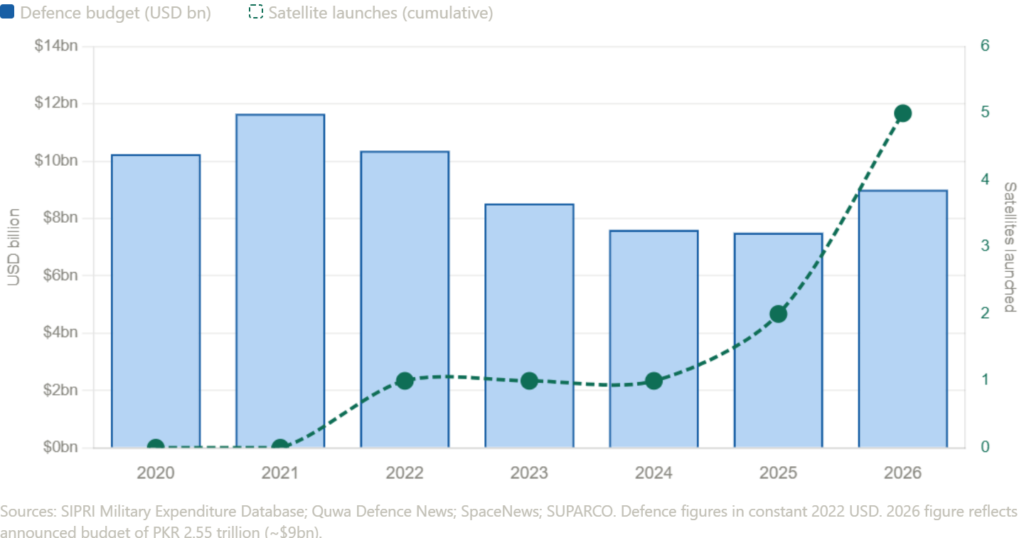
This development comes at a time when the region is already under stress. India’s military strikes against Pakistan through Operation Sindoor, in May 2025, were the most serious India-Pakistan confrontation in close to three decades, and they exposed how significantly the strategic environment had shifted. In the aftermath of Operation Sindoor, India sanctioned a 52-satellite space surveillance programme that cost around $2.8 Billion. In this aspect, what role does Pakistan’s completed constellation play strategically, what is China’s role in the evolving bilateral relation, and how does the absence of regional space security governance make this development consequential beyond the bilateral?
Pakistan’s EO Programme
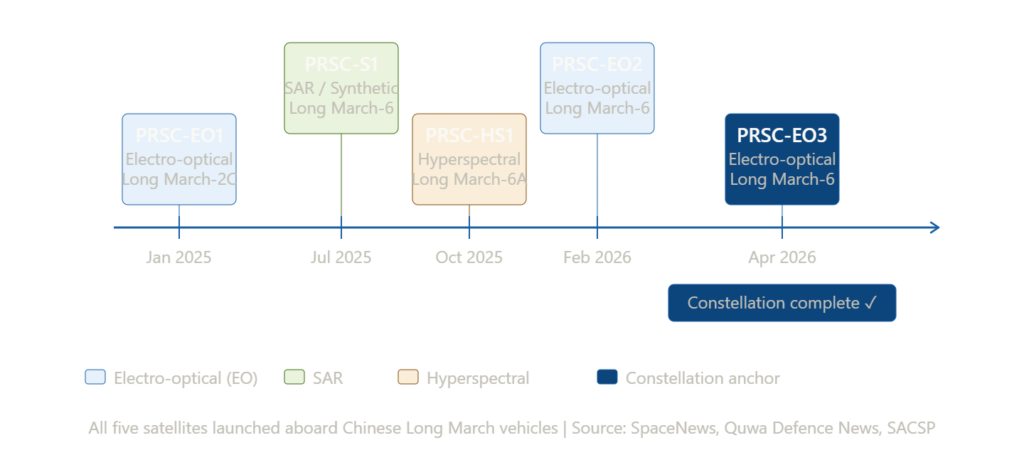
Pakistan’s space research organisation ,the Space & Upper Atmosphere Research Commission (SUPARCO), was established in 1961, and spent decades as one of Asia’s most underused space research programs. However, recent years have seen a significant acceleration in SUPARCO’s work. Between January 2025 and April 2026, Pakistan managed to place five satellites into orbit – PRSC-EO1 (January 2025), PRSC-S1 (July 2025), PRSC-HS1 Hyperspectral (October 2025), PRSC-EO2 (February 2026), and PRSC-EO3 (April 2026). All these missions were possible thanks to Chinese launch vehicles under a 2022 agreement with China Great Wall Industry Corporation (CGWIC).
The PRSC-EO3 alone represents a technical step forward. It comes with onboard AI processing and a Multi-Geometry Imaging Module, with the optical resolution believed to be approaching the one-metre class, which is sufficient for high-value military intelligence, military installations, identifying vehicle types, and assessing infrastructure changes. Pakistan officially claims that the purpose of the constellation is to serve in agriculture, disaster management, and environment monitoring. The dual-use nature of high-resolution EO satellites, however, is well established in the academic literature. As Bleddyn Bowen argues in War in Space (2020), space-based earth observation systems are inherently dual-use instruments. As a result, their utility for military intelligence collection cannot be separated from their civilian application by design or declaration alone.
The completion of this constellation transforms Pakistan’s ISR posture significantly. Three coordinated satellites in sun-synchronous orbits enable persistent, repeatable coverage of targets across the subcontinent, a capability fundamentally different from the episodic imagery access Pakistan previously depended upon.
The China Factor: Strategic Enablement and Its Implications
The pace and depth of Chinese support towards Islamabad’s space program demands attention. Five satellites have been launched in 18 months, all of which were executed by the CGWIC-SUPARCO framework agreement, which constitutes a systematic programme of strategic infrastructure development, and not just routine commercial activity. This was further reinforced by the February 2025 Bilateral Astronaut Cooperation Agreement, under which two Pakistani candidates arrived in Beijing for training at the Astronaut Centre of China in April 2026. One is scheduled to visit the Tiangong Space Station by the end of the year.
Andrew Small, in his work, The China-Pakistan Axis (2015), documents how Chinese strategic support to Pakistan consistently operates across multiple domains simultaneously, ranging from economic to military, to diplomatic, with each domain reinforcing the others. According to some analysts, the partnership between the two states has evolved from basic satellite launches into a comprehensive “Space Silk Road”, with Pakistan now a part of Chinese space infrastructure spanning lunar exploration, astronaut training, and satellite communications development. This could be seen as China’s broader pattern of building strategic dependency on its partner states through space technology cooperation- a dynamic that could shift China’s positioning from passive observer to active participant in a Chinese-led space architecture.
From Beijing’s perspective, the logic is clear. Pakistani EO capability provides Islamabad with independent surveillance technology of India’s military activities, which complicates India’s strategic planning on its western flank, while deepening Pakistani structural dependency on Chinese infrastructure. This serves Chinese strategic interests without Beijing getting involved in South Asia’s tensions.
Strategic Implications: ISR, Operation Sindoor, and Regional Stability
The military implications of Pakistan’s completed constellation must be understood against the post-Operation Sindoor regional environment. India’s strikes in May 2025 demonstrated both the effectiveness of precision ISR-enabled military action and Pakistan’s vulnerability to information asymmetry during a fast-moving crisis. The EO programme’s acceleration in the eighteen months spanning and following that confrontation is not coincidental.
With independent EO capabilities, Pakistan can now conduct battle damage assessment following strikes on its territory, monitor Indian force concentrations along the Line of Control and the international border, track movements of the Indian Navy within the Arabian Sea, and assess the construction and status of Indian military infrastructure, all without third-party imagery providers. For a state whose nuclear doctrine is built around Full Spectrum Deterrence, including tactical nuclear option, improved ISR capability has direct implications for nuclear posturing and crisis stability (Nuclear Strategy in the Modern Era, Vipin Narang, 2014).
India’s strategic response has been swift and significant . The approval of 52 dedicated military surveillance satellites under SBS-3 represents the largest single investment in India’s space-based military infrastructure. This is explicitly designed to provide constant monitoring of China, Pakistan, and the Indian Ocean Region. The deployment timeline (first launches scheduled for 2026) ensures that both states will be expanding their orbital ISR capabilities simultaneously without the constraints of governance frameworks to manage them.
South Asia is clearly entering a period of accelerating space competition without the confidence-building measures, communication protocols, or multilateral frameworks that have partially stabilised other domains of the India-Pakistan rivalry. The nuclear domain has hotlines and agreed doctrinal constraints. The space domain possesses neither of these, and the pace of current development suggests little prospect of their emergence in the near term.
Conclusion
Pakistan’s completed EO constellation is a strategic inflexion point that existing analytical frameworks have insufficiently addressed. It is an expansion of the India-Pakistan rivalry into a new domain, with the passive presence of China’s infrastructural partnership with Islamabad driving a growing gap in the pace of South Asian space competition. After launching five satellites in eighteen months, preparing a Pakistani astronaut for the Tiangong Space Station, and India’s 52-satellite response programme, there is little doubt that space technology and surveillance competition are now central to South Asian security frameworks. The question now is not whether the competition will intensify, but whether any regional or multilateral framework can be developed fast enough to prevent destabilising consequences.