
The Himalayan Climate in Transition
The melting of the Arctic has become one of the most familiar stories in geopolitics. As the ice retreats, new sea routes open and global trade patterns shift with them. A similar story is unfolding in the Himalayas, with far less attention. Here too, climate change is redrawing trade routes and closing old ones, forcing governments and traders to adapt to a rapidly changing landscape.
Nepal offers one of the clearest examples of this shift, because Nepal’s trade with China has been shifting west toward a pass in Mustang District, Nepal, called Korala. The reason isn’t policy or trade agreements. It’s climate change, and specifically the growing frequency of glacial lake outburst floods across the Hindu Kush Himalaya.
The International Centre for Integrated Mountain Development has recorded three separate floods in Nepal, Afghanistan, and Pakistan within a two month window in 2025, a pace its own scientists called unprecedented in a press release covering the region. Roads and border posts across these mountains simply weren’t designed for this.
To understand why Korala is gaining importance, it is worth looking closely at Nepal’s northern frontier. Nepal shares several border crossings with China. Running from west to east, these are Hilsa and Yari in Humla, Korala in Mustang, Rasuwagadhi in Rasuwa, Tatopani in Sindhupalchok, and Kimathanka in Sankhuwasabha. In practice, however, the vast majority of bilateral trade has historically moved through Rasuwagadhi and Tatopani.
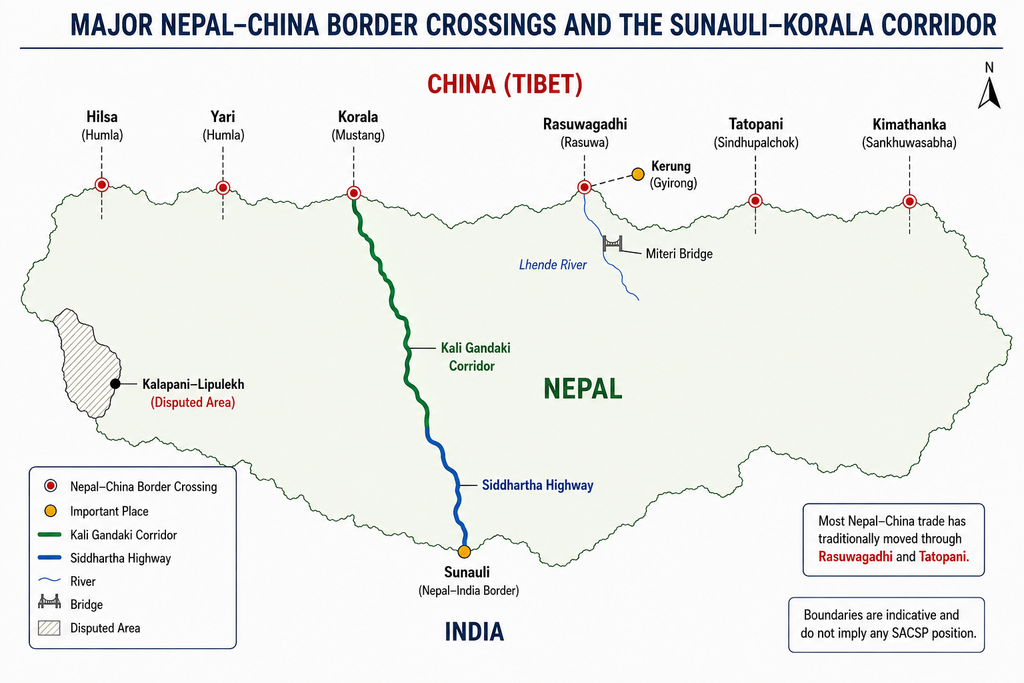
Map created by the author using AI.
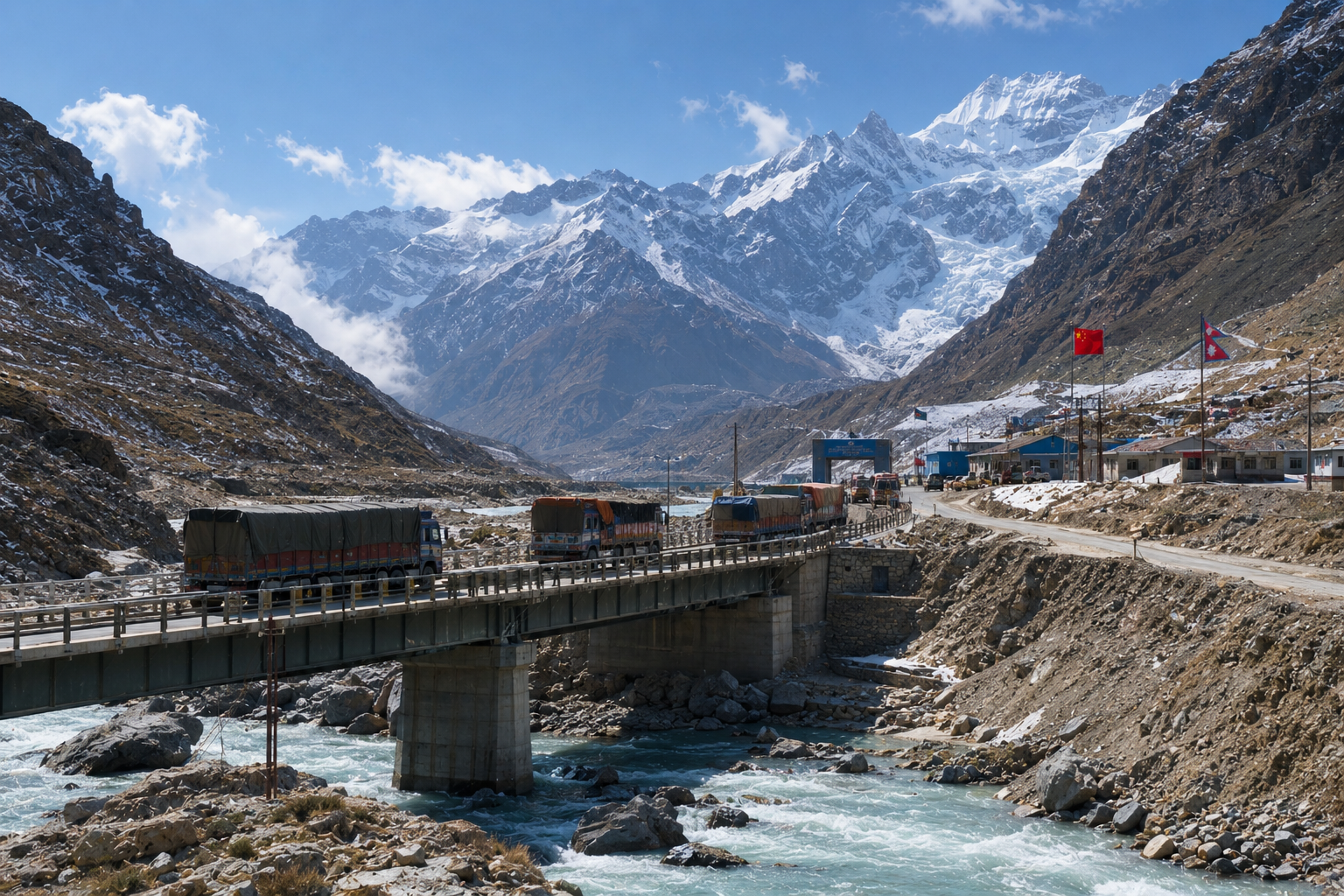
Furthermore, Nepal’s turn came in July 2025. A glacial lake above the Lhende River in Tibet burst and destroyed the Miteri Bridge, the main link between Rasuwagadhi and the Chinese border town of Kerung. As a result, Rasuwagadhi’s Closure pushed Chinese trade toward Korala within weeks.
Korala’s Unexpected Rise
By January 2026 a temporary bridge had reopened Rasuwagadhi. Trade didn’t return to what it had been. Nepal’s Department of Customs, reported by the Kathmandu Post, shows Korala handling Rs 11.68 billion in imports over six months. Rasuwagadhi, even reopened, managed only Rs 2.03 billion in the same stretch.
Mustang’s customs chief Bidur Chudal says officers lack scanners and staff, forcing them to check growing cargo shipments by hand.
The numbers back this up from more than one direction. Republica reported Rs 5.27 billion moving through Korala in just three months, over five percent of everything Nepal imports from China. Rising Nepal Daily tracked customs staff clearing snow off Border Pillar 24 in minus 15 degree cold to keep trucks moving, with more than 1,700 electric vehicles crossing since trade resumed in mid-September.
Available evidence suggests that Nepal doesn’t trade with China through only three mountain crossings, though that number gets repeated a lot. There are working customs offices at Rasuwagadhi, Tatopani, Yari, and Korala, and a fifth point at Kimathanka is being built right now. Korala happened to be the one still open when the other two heavier routes both went down together. Yari, further west near Humla, mostly serves local and pilgrimage traffic toward Kailash and Mansarovar, which is part of why it rarely comes up in discussions about the trade squeeze.
The Indian Dimension
India’s position adds a further dimension, and it is visible in Korala’s road connection to the Indian border. The Korala road runs down the Kali Gandaki valley and joins the Siddhartha Highway, which continues south to the Sunauli crossing. Sunauli is one of the principal transit points between Nepal and India.
However, Korala is getting more attention due to its significant location along the Kali Gandaki corridor. This route connects Sunauli on the Nepal-India border, and this corridor has the potential to enhance north-south connectivity among Nepal, India and China. In the longer term, such connectivity could contribute to a wider trans-Himalayan Multi-Dimensional Connectivity Network and enhance the link between South Asia with the Tibetan Plateau. However, it’s uncertain how things will be in the future. Together, however, these roads form the Sunauli-Korala Trade Arterial Road, an important economic highway connecting the Indian subcontinent directly to China and the Tibetan Plateau.
Notably, Korala is also one of six crossings named under Nepal’s 2016 Transit Protocol with China, an agreement meant to turn Nepal from landlocked into what officials there call land linked.
Furthermore, the evolving pattern of India-China border engagement points to a preference for direct connectivity. Recent initiatives involving Shipki-La, Lipulekh, and Nathu-La demonstrate New Delhi’s interest in maintaining multiple channels of commercial and people-to-people interaction without routing them through Nepali territory.
None of those routes touch Nepali soil. The Central Tibetan Administration reported only 55 traders applied for the first Shipki La season, with goods still exchanged through barter rather than formal customs. It’s a small start, but India clearly wasn’t waiting around for Nepal to open a door for it.
This matters for India’s own calculations. With India building and reopening its own crossings, the Korala route may not carry the same weight for Delhi. India has also been wary of Chinese-linked roads near its northern border, particularly around Kalapani and Lipulekh.
Put the three sides together and you don’t get a clean story about three countries getting closer. Nepal is patching a gap left by a disaster, using a crossing its own officials say is understaffed and under equipped. However, China gains a low-cost backup route, and is supported by better infrastructure on its side. India, meanwhile, continues to develop its own infrastructure and alternatives in the Himalayas, particularly along its border with China, rather than relying solely on a single corridor.
Climate Change and the Future of Himalayan Connectivity
What ties all of it together is simpler than the geopolitics. A single glacial flood in Tibet reshaped which crossing Nepal depends on, and that reshuffling is now sitting inside decisions being made in Delhi about its own border infrastructure. The climate side of this story isn’t a footnote to the trade story. It’s the reason any of this is happening at all. Most importantly, the Korala’s rise may signal to the policymakers that they need to rethink about Himalayan connectivity. No doubt, for decades, trade routes were largely discussed in terms of economics, strategic competition, and regional diplomacy.
The events of the past year suggest another dimension is becoming hard to overlook. Border crossings once considered secondary can suddenly become critical when floods, landslides or other climate-induced disasters disrupt established routes.
For Nepal, that means investing not only in new infrastructure but in alternatives and adaptability. For the wider region, it is a reminder that climate change is beginning to shape geopolitical outcomes in ways that are still largely overlooked. As environmental pressure grows across the Himalayas, geography itself is becoming less fixed, reshaping the region’s networks of connectivity and interaction.