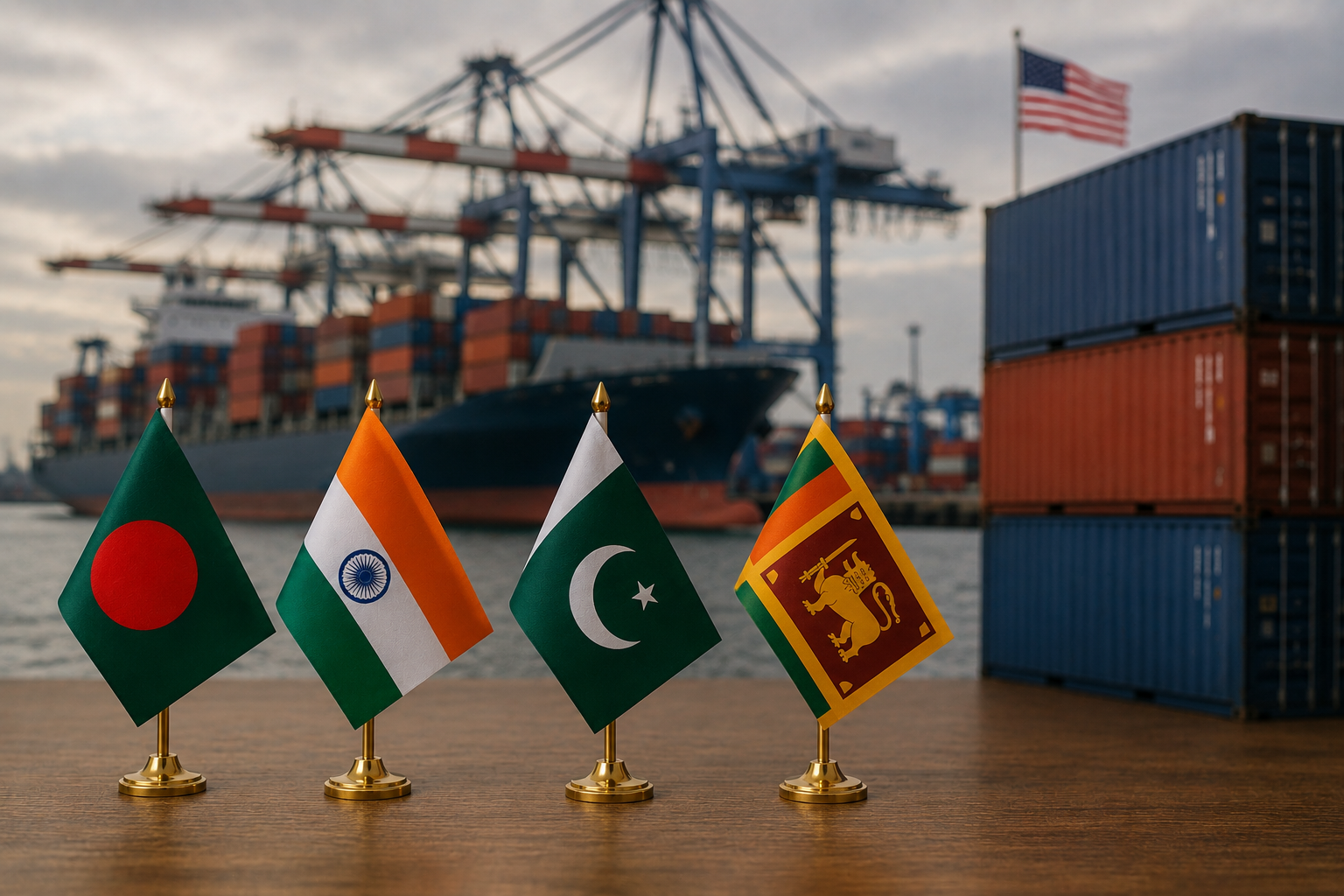
The case for treating volatility as the primary risk, rather than the rate itself, rests on how quickly South Asia’s tariff position has moved since Liberation Day. In February 2026, India’s rate fell from 50 percent to 18 percent under a bilateral deal; Bangladesh secured 19 percent days before its election; Pakistan and Sri Lanka settled at similar rates. That foundation collapsed on 20 February, when the US Supreme Court ruled 6–3 that the International Emergency Economic Powers Act (IEEPA) does not authorise tariffs at all, striking down every bilateral rate at once.
Washington pivoted within days to Section 122 of the Trade Act, a blanket 10 percent rate, capped by law at 150 days, erasing months of bespoke diplomacy overnight. India’s painstakingly negotiated 18 percent fell to 10 not because of anything New Delhi did, but because a US court had ruled on a separation-of-powers question. When that rate expired on 24 July, it was replaced in the same instant by a new Section 301 tariff arising from a United States Trade Representative (USTR) investigation into forced-labour enforcement across 60 economies. Three legal instruments, three different bases for South Asia’s access to the US market inside six months, and all independent from the actions of any South Asian government.
A Hierarchy Beneath the Parity
The Section 301 action is the regime now in force, and it is where the current asymmetry lives. Of 60 economies investigated, USTR sorted 19 into a preferential tier that was subject to 10 percent rather than 12.5 percent and remarkably, India, Bangladesh, Pakistan and Sri Lanka all landed inside it. Bangladeshi industry hailed a “2.5 percentage point edge“ over Vietnam and China, and Sri Lanka’s apparel association credited swift government diplomacy. What this celebration obscures is a second sorting mechanism in the same USTR order: Tariff Rate Quotas (TRQs) allowing duty-free textile import entry tied to purchases of US inputs, not yet activated but promised no earlier than September 2026.
Bangladesh, India and Sri Lanka all reached the 10 percent tier by committing to a forced-labour prohibition: first Bangladesh, through its February trade agreement, then India and Sri Lanka between June and July; Pakistan qualified on the strength of an existing domestic law that USTR judged too weakly enforced to earn any further relief. But the TRQ is a separate and narrower incentive that the USTR ties to a negotiated commitment to import US cotton and textile inputs, a sourcing concession that only Bangladesh, among the four, made. India, Pakistan and Sri Lanka, despite sharing Bangladesh’s headline rate, are excluded outright. Thus, while the four achieve “rate-parity,” one has a path to deeper market access the other three do not, decided by a sourcing pledge rather than anything resembling comparative advantage.
Why the Process Is the Risk
Small percentages are easy to erroneously dismiss as marginal stakes. Ready-made garments generate more than 80 percent of Bangladesh’s export earnings and employ roughly four million workers, underwriting close to a tenth of GDP. Apparel is one of Sri Lanka’s largest foreign-exchange earners, still central to a post-crisis recovery; textiles form the overwhelming majority of Pakistan’s US-bound exports; India’s textile and apparel exports exceeded $33.5 billion in FY26. For Dhaka and Colombo in particular, this sector’s fortunes are bound up with the political survival of governments that took office promising economic relief. The World Bank already flags US tariffs among the reasons regional growth will slow to 6.3 percent in 2026. But it is the unpredictability of the process deciding the tariff level, not the number itself, that is the salient problem.
A Supreme Court ruling erased months of diplomacy overnight; the Section 301 regime is already being challenged in the US Court of International Trade, and could yet be struck down or revised again. No exporter, ministry or investor in South Asia can plan sourcing, pricing or diversification in the long-term with confidence that today’s rate survives the next fiscal quarter, let alone the next ruling. That is an economic-security exposure on par with currency or debt vulnerability, for economies that draw a fifth or more of export earnings from a single market.
What worsens this exposure is that South Asia has no regional fallback to lean on. SAFTA, in force since 2006, remains hollowed out by “sensitive lists” that exempt large categories of goods from liberalisation. A World Bank assessment found that Bangladesh alone shields nearly half its regional imports this way, and that intraregional trade in South Asia has held at 3 percent of imports and 6–7 percent of exports for over a decade, a fraction of East Asia’s integration. Each government has therefore negotiated Washington alone rather than pooling leverage or information, competing against neighbours who share its exposure almost exactly.
Conclusions/Implications
Three implications follow from the argument developed above. South Asian governments should treat US regulatory volatility as a standing risk category, tracked jointly rather than managed reactively each time Washington acts. A light shared trade-intelligence function, housed at the SAARC secretariat or run informally among commerce ministries, would let the region anticipate rather than merely absorb the next reshuffle. Because a negotiated sourcing pledge decided access to the TRQ, and enforcement timing separately decided the tariff tier, both compliance capacity and sourcing diplomacy should be treated as instruments of trade security in their own right as opposed to afterthoughts to be tidied up in reaction to tariffs. And the case for shrinking SAFTA’s sensitive lists has never been stronger, as insurance against a volatile regulatory process that has reshuffled the region’s access three times in a single year and is still being litigated. A region that trades a little more with itself is a region a little less hostage to the next ruling out of Washington.